

Breathwork has a reputation problem, and it is mostly the internet’s fault.
Search the word and you will find people lying on studio floors shaking, weeping, or being talked through something that looks closer to an exorcism than an evening class. It makes for compelling video. It is also almost nothing like what happens on a Tuesday in Warwick.
At Heist (formerly Heist House Studios), breathwork is the class people ask the most questions about before they book, usually in the doorway and usually a little sheepishly. Is it the intense one. Will I cry. Do I have to say anything.
So here are the answers, written down properly.
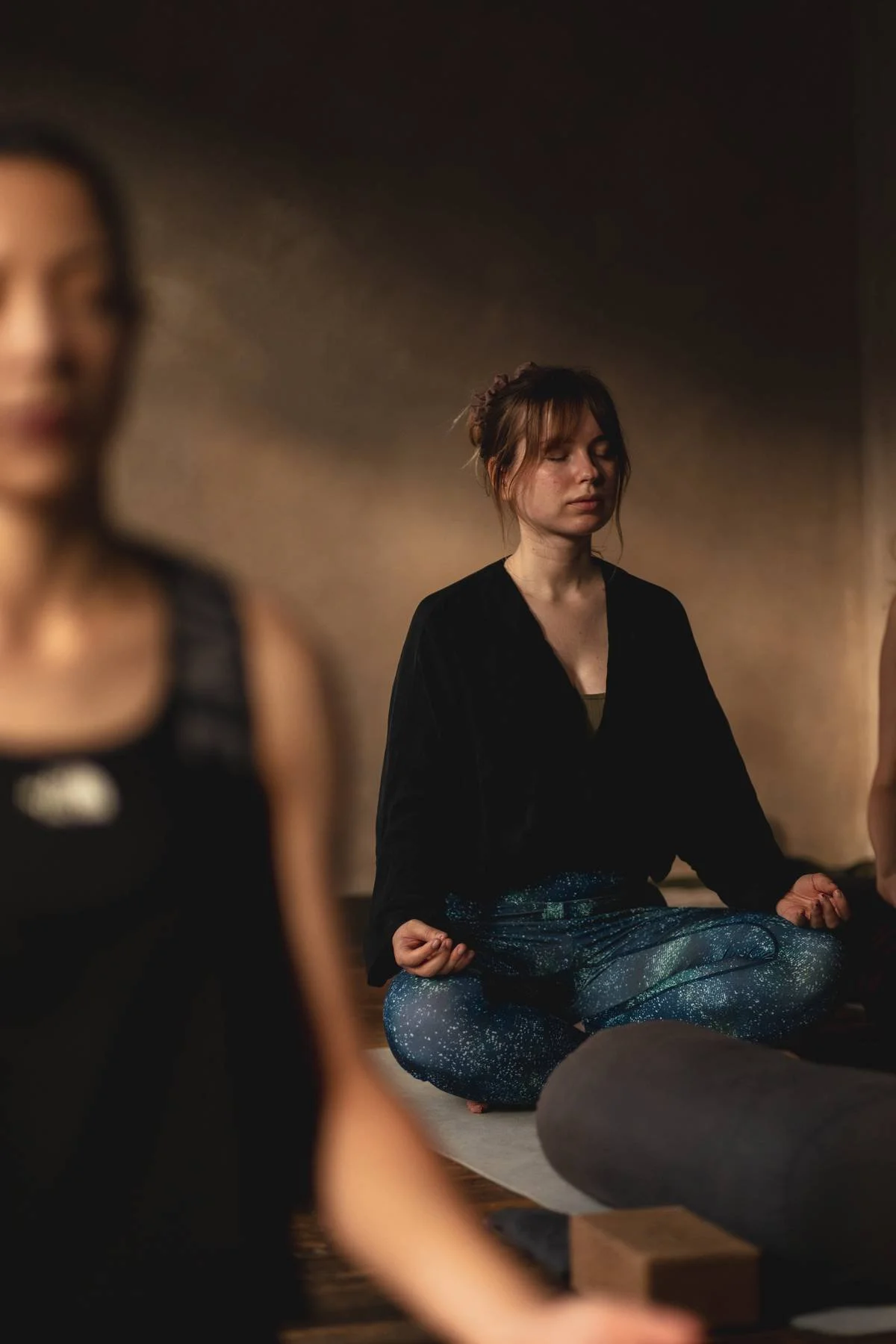
A guided breathwork session at Heist, where the work is far quieter than most people expect.
Several Different Things Are Called Breathwork
Most of the confusion comes from one word being stretched across practices that have almost nothing in common. It is worth separating them out, because what you have seen online is probably not what is on our timetable.
Slow, regulating breathwork
Structured breathing designed to settle the nervous system. Long exhales, sometimes a count, sometimes a pause at the top or the bottom of the breath. It is deliberately undramatic.
You stay completely in control. You can stop at any point. The effect is closer to how you feel after a long walk than to anything cathartic.
This is the foundation of what we teach, and it is where everybody starts.
Conscious connected breathing
This is the one that gets filmed. A continuous breath with no pause between the inhale and the exhale, sustained for a long stretch, usually lying down with music.
It can bring up strong physical sensation and strong emotion, which is rather the point of it. It is also why it belongs in a longer workshop with an experienced practitioner, not in a drop in class on a weeknight. When we run it, we say so plainly on the booking page.
Breathwork inside a yoga class
Many of our classes already open and close with five or ten minutes of breath. If you have been to yin yoga or restorative yoga with us, you have already done breathwork.
You may simply not have called it that.
What an Hour at Heist Is Actually Like
Our studio is a first floor room on Warwick High Street, in one of the oldest bank buildings in the town. Tall windows, wooden floor, not much noise finding its way up from the street.
You arrive and you get propped. Bolster under the knees, blanket over you, an eye pillow if you want one. Everything is here, so you bring yourself and some water.
The session opens with a few minutes of noticing how you are already breathing, without changing anything. It sounds like filler. It turns out to be most of the work, because almost nobody arrives breathing in a way that would help them.
Then the teacher introduces one pattern. Slowly, out loud, with time to get it wrong. You practise it in short rounds with rests in between rather than in one long stretch.
The middle of the class is the longest held practice, usually ten or fifteen minutes in a gentle session. The teacher keeps talking throughout, so you are never left wondering whether you are doing it right.
Then it stops. You lie there. Nobody asks anything of you for ten minutes.
Most people find that last part is the bit they actually came for.

Bolsters, blocks and a mat laid out before a session, with the afternoon light coming through.
Nobody Is Going to Make You Do Anything
Worth saying clearly, because it is the quiet worry underneath most of the questions.
Nobody will touch you without asking first.
Nobody will ask you to share anything with the room.
If you want to stop and breathe normally at any point, you stop and breathe normally.
If you want to spend the whole hour lying under a blanket doing very little, that is a perfectly good use of the class.
You can keep your eyes open the entire time.
Our classes are small, which is the part that makes all of the above true rather than aspirational. A teacher can only adapt to a room they can actually see.
The Patterns You Will Actually Be Taught
There is no single thing called the breathwork breath. There are a handful of patterns, each doing a slightly different job, and over a few weeks you will meet most of them.
The extended exhale. Making the out breath longer than the in breath, often four in and six or eight out. This is the backbone of a gentle class, because the exhale is where the slowing actually happens. If you only ever take one thing away from a class, take this one.
Coherent breathing. Breathing at around five or six breaths a minute, in and out through the nose, with no holds. It sounds mechanical and feels surprisingly pleasant. This is roughly the rate at which heart rate variability tends to peak, which is why it shows up in most of the research.
Box breathing. Equal counts all the way round. In for four, hold for four, out for four, hold for four. People who like structure take to it immediately. It is better for steadying and focusing than for sending you to sleep, so it suits a morning rather than a bedtime.
The physiological sigh. Two inhales through the nose, the second one shorter and stacked on top of the first, then a long slow exhale through the mouth. It works fast, which makes it the useful one to have in your pocket for an actual difficult moment.
You are not expected to remember all four. Most people end up with one favourite and use it for years.
Why Hands Tingle, and Why People Sometimes Cry
Two things happen often enough that they are worth explaining in advance, so they do not frighten you when they arrive.
Tingling in the hands, feet or around the mouth. This is a normal response to the change in carbon dioxide levels that comes with breathing more than usual. It passes within a minute of returning to a normal breath. It is not a sign that anything is wrong, though it is a reliable sign to slow down, and a good teacher will tell you so before you need to know it.
Emotion arriving without a story attached. Some people well up during a long exhale practice with no idea why, which is disconcerting if you are not expecting it.
There is a physiological explanation involving the vagus nerve and the shift out of a sustained stress response. There is also a simpler one, which is that most adults very rarely lie still for twenty minutes with nothing to do and nothing to look at.
Either way it is common, nobody in the room will react, and you are not obliged to explain it to anybody. We have written more about this in why yoga doesn’t always feel relaxing at first, because the same thing happens on a mat.
What Breathwork Is Good For
Worth being careful here, because this is a field where very confident claims get made that the evidence does not support.
What is well supported is narrower and more useful than the claims. Slow breathing with an extended exhale produces measurable shifts in heart rate variability and in the balance between the two branches of the autonomic nervous system. In plain language, it reliably takes the edge off acute stress, which is why the NHS recommends breathing exercises for exactly that.
What people tell us, consistently, is more specific:
Getting to sleep more easily, which is the one we hear about most.
The particular knot of tension that sits between the shoulder blades.
The sensation of being braced all day without being able to name what for.
Something to reach for in the ten minutes before a difficult conversation.
That last one is the real value. A class teaches you a pattern. The pattern then belongs to you, and it works in a car park or at a desk as well as it does on a bolster.
We have written separately about how yoga supports sleep and about burnout and the nervous system, both of which overlap with this.
What breathwork is not is a treatment for a medical or psychiatric condition. If that is what you need, you need a clinician, and any teacher worth going to will say so.
Breathwork and Meditation Are Not the Same Thing
People use the two words interchangeably. They are different practices making different demands on you.
Meditation largely asks you to observe without intervening. For a lot of people that is genuinely difficult, particularly when the mind is busy, and the difficulty itself becomes the reason they stop.
Breathwork gives you something to do. There is a pattern, there is a count, and there is a teacher’s voice carrying you through it.
It is a far easier entry point if sitting alone with your own thoughts has never worked for you. Plenty of people find that meditation becomes possible afterwards, once the system has already come down a few notches. That is also why breathwork sits so comfortably next to our sound baths, where the job is similar and you have even less to do.
Who Should Check With a Doctor First
Breathwork is gentle, but it is not neutral, and the stronger practices in particular are not appropriate for everyone. Speak to your GP or midwife before booking if any of these apply to you.
Pregnancy, at any stage.
Epilepsy or any seizure disorder.
Cardiovascular conditions, including uncontrolled high blood pressure.
Glaucoma or a detached retina.
A history of aneurysm.
Severe or poorly controlled asthma.
Recent surgery.
A diagnosis of psychosis, bipolar disorder or a severe anxiety disorder.
Tell your teacher as well. We would always rather know, and there is almost always a gentler version of the practice you can do instead. If you are pregnant, our pregnancy and antenatal classes are the better place to start.
What the First Few Weeks Usually Look Like
The first session is often the most striking one, partly through novelty and mostly because of the ten minutes of rest at the end. Some people sleep unusually well that night. Others feel oddly wide awake, which tends to surprise them. Both are normal, and the second one usually stops happening by the third or fourth class.
By weeks two to four the counting gets quieter. You stop concentrating quite so hard on getting the pattern right, and that is the point at which it starts to do something, because the effort of doing it correctly was itself keeping you alert.
Somewhere around week four to six, most people notice it turning up uninvited. In traffic, in a waiting room, in the ninety seconds before a conversation they have been dreading. That is the practice working, and it is a much better measure than anything that happens in the room.
You will also have a flat session at some point, where nothing much happens and you wonder what the fuss is about. Everybody does. It is not a sign to stop.
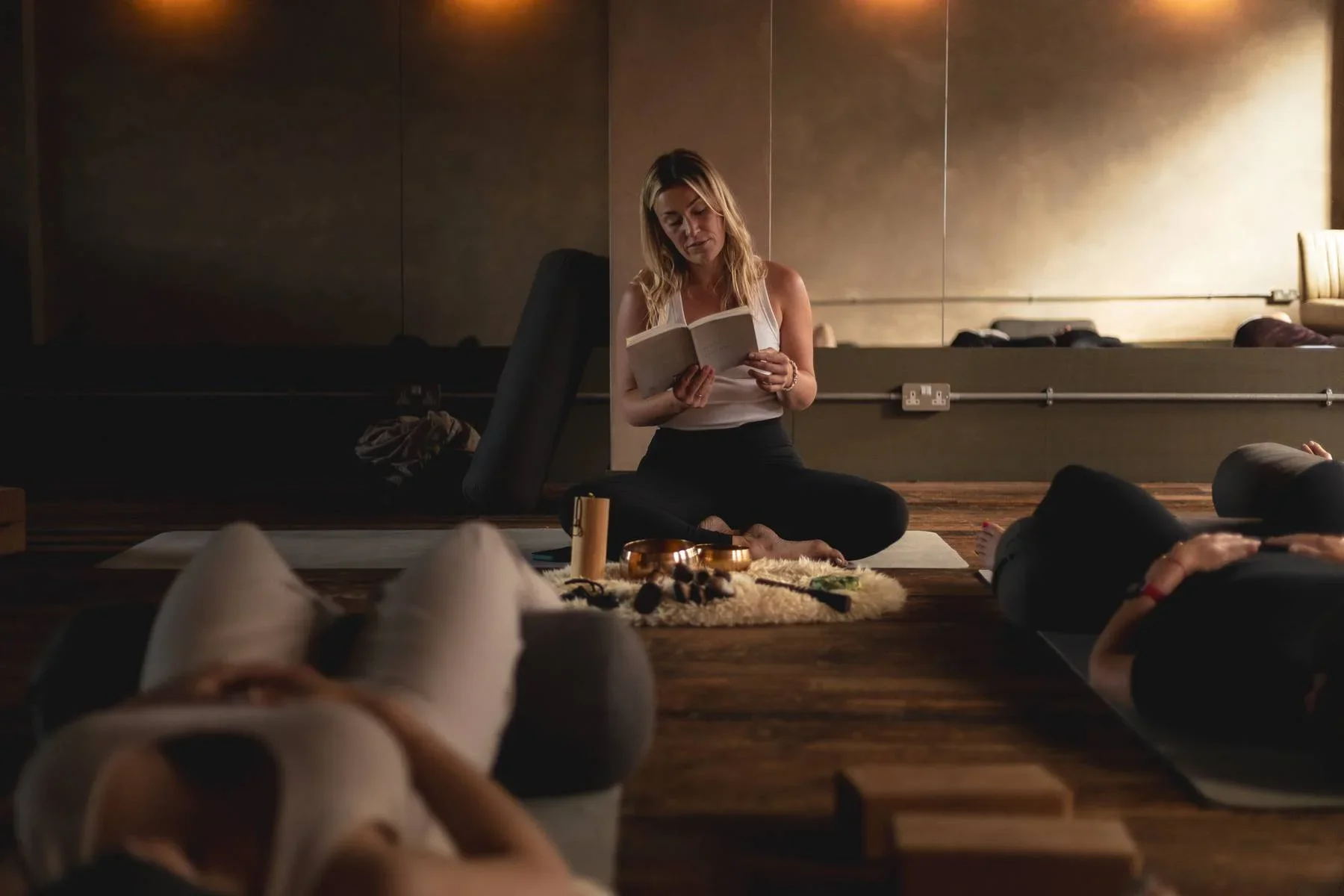
The teacher talks you through it from start to finish, so there is nothing to remember beforehand.
Your First Class
If it is your first time with us, a few practical things.
Wear something comfortable and warm, and bring a layer, because you will cool down lying still. Bring water. Mats, bolsters, blocks, blankets and eye pillows are all here, so there is nothing to buy.
Arrive five or ten minutes early if you can. Not for any spiritual reason, simply because rushing in is a poor start to an hour about not rushing.
There is parking on Warwick High Street and the Market Square car park is two minutes away. If you are coming from Leamington Spa or Kenilworth it is ten to twelve minutes either way.
Your first class is £5. If breathwork turns out not to be for you, you will have found that out for the price of a coffee.
Where Breathwork Sits Alongside Everything Else
People often arrive at breathwork sideways, through a class they came to for another reason.
If you want to move first and breathe second, flow and slow flow both open and close with breath.
If you want stillness, yin is the closest neighbour.
If you want to do as little as humanly possible, restorative or a sound bath.
If you have never done any of it, beginners is built for exactly that.
If you want a longer stretch of it, our half day retreats and retreats give the breath far more room than an hour ever can.
The full week is on our timetable, and class packs and memberships are there if you want to come regularly.
Frequently Asked Questions
Do I need to have done yoga before? No. Breathwork is a separate practice and a good number of the people who come to it have never set foot in a yoga class. If you would rather start on a mat, our beginners classes are built for a genuine first time.
Is breathwork hard? The gentle practice is not physically hard at all. You are lying down for most of it. What some people find difficult is staying still and doing one thing for twenty minutes, and that gets easier faster than you would think.
Will I be asked to share anything? No. You can arrive, breathe, and leave without saying a word to anybody.
Is breathwork the same as meditation? No. Meditation asks you to observe. Breathwork gives you a pattern to follow and a voice guiding you through it, which most people find considerably easier to start with.
Can I do breathwork if I am pregnant? Speak to your midwife first. Some gentle practices are appropriate throughout pregnancy and some are not, and that is not a decision for a yoga teacher to make. Our pregnancy and antenatal classes are designed around it.
How often should I do it? Once a week in class is plenty to notice a difference. Most of the lasting value comes from the few minutes you then do on your own, at home, on a bad day.
A Final Note from Kate
The thing nobody tells you about breathing is that you are already an expert at it, and have been since the day you were born. Nothing in a breathwork class is new to your body. All we are doing is putting a quiet hour around something you do twenty thousand times a day without noticing.
That is also why it travels so well. You cannot take the studio home with you, but you can take the breath, and most weeks that turns out to be the more useful of the two.
Come and try it. Lie down, do very little, and see what happens.
-Kate x
References
Zaccaro, A. et al. (2018) How Breath Control Can Change Your Life: A Systematic Review on Psycho Physiological Correlates of Slow Breathing. Frontiers in Human Neuroscience.
Balban, M. Y. et al. (2023) Brief structured respiration practices enhance mood and reduce physiological arousal. Cell Reports Medicine.
Russo, M. A., Santarelli, D. M. and O’Rourke, D. (2017) The physiological effects of slow breathing in the healthy human. Breathe, European Respiratory Society.
Lehrer, P. M. and Gevirtz, R. (2014) Heart rate variability biofeedback: how and why does it work? Frontiers in Psychology.
Porges, S. W. (2011) The Polyvagal Theory: Neurophysiological Foundations of Emotions, Attachment, Communication and Self Regulation. W. W. Norton & Company.
